


Volkswagen IQ.DRIVE Travel Assist Features
Driving shouldn’t wear you out. Volkswagen’s IQ.DRIVE Travel Assist brings together a set of driver assistance technologies that take some of the mental work off your plate, whether you’re crawling through morning traffic or logging highway miles on a road trip. The features work quietly in the background so your attention can stay where it belongs: on the road ahead.
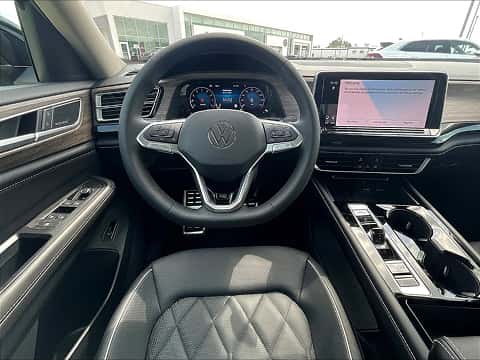
IQ.DRIVE Travel Assist: Smarter Driving for Every Journey
Driving today asks a lot of your brain. You’re watching your speed, tracking the car in front of you, staying inside your lane, and scanning for anything unexpected, all at once. That adds up over time. IQ.DRIVE Travel Assist takes on several of these routine tasks, giving you what Volkswagen calls a semi-automated, hands-on driving experience.
The point isn’t to take the driver out of the picture. It’s to make the job lighter. Travel Assist handles the repetitive parts of driving so you can stay alert without wearing down the way you normally would on a long stretch behind the wheel. You tend to notice this system most in how much easier the drive feels once it kicks in, not in any single dramatic thing it does.
What Is IQ.DRIVE Travel Assist?
IQ.DRIVE Travel Assist pairs Adaptive Cruise Control with Lane Assist, keeping a preset following distance while helping your vehicle stay centered on the road. Radar sensors and front-facing cameras read the environment around you continuously, and the system makes small, real-time adjustments to speed and steering as conditions shift. Once it’s activated, Travel Assist operates anywhere between 0 and 95 mph, which means it stays with you all the way down to a full stop in traffic.
Worth knowing up front: you can’t switch it on from a standstill. You need to be moving above a minimum speed to engage it, which is 15 mph on some models and 20 mph on others. Get it running on the highway or as traffic starts flowing again, and it will follow you down into the stop-and-go from there.
Turning it on is simple. Engage Adaptive Cruise Control first, then press the ACC button on the steering wheel to switch over to Travel Assist. A green indicator light in your digital cockpit confirms it’s running. Accelerate to your preferred speed and press SET to lock it in. Tap the brake pedal to drop out, press RES to pick back up, and press ACC again if you’d rather go back to plain adaptive cruise.
Travel Assist won’t take the drive off your hands. Think of it more as a capable co-pilot handling the fine details while you stay in charge overall. In practice, that might look like a gentle steering correction through a curve, or the car easing off the gas smoothly as traffic ahead slows. Brake lights come on up the road, and Travel Assist decelerates right along with them. Drift too close to a lane marker, and the system nudges you back where you belong.
How It Fits Within the IQ.DRIVE Suite
Travel Assist isn’t a standalone feature. It’s part of Volkswagen’s larger IQ.DRIVE suite, alongside Adaptive Cruise Control, Lane Assist, Front Assist, Emergency Assist, and Active Blind Spot Monitor. Volkswagen built these to work as a coordinated system rather than a collection of separate tools.
That layered setup gives drivers consistent support no matter the situation, city streets or open highway. Travel Assist sits near the center of that suite, pulling together more of the individual functions than any other single feature. And for 2026, availability isn’t a question mark: every new automatic Volkswagen for the 2026 model year comes standard with IQ.DRIVE.
How Travel Assist Works Behind the Wheel
Radar sensors and front-facing cameras feed data into onboard software that’s constantly reading what’s happening around your car. That real-time picture lets the system make adjustments that feel natural rather than robotic.
Travel Assist works across a wide speed range, but it really earns its keep on highways and expressways, where staying focused for long stretches gets hard. Once it’s active, two things happen at the same time: your vehicle stays centered in its lane, and your speed adjusts relative to the traffic around you.
Because the whole thing depends on those sensors seeing clearly, a few practical things can interfere. Ice and snow buildup, dirt, mud, or leaves covering a sensor can disable the system or cause unexpected braking, which is worth remembering through an Illinois winter. Sensor damage or misalignment does the same. So does towing a heavy trailer or loading heavy cargo in the back, since raising the nose of the vehicle changes the angle the sensors are pointed at. Keeping the front of the car clean is most of what the system asks of you.
Lane Centering and Steering Support
Camera data picks up lane markings, and the system provides light steering input to keep you positioned correctly. The car needs to be able to see clear road markings for this to work, and when it can, your digital cockpit shows green lanes alongside the green indicator light.
That matters most on long highway drives, where your focus can slip without you even noticing. The system stays alert even when you’re not at your sharpest, adding a quiet backstop against drifting out of your lane. A few conditions can limit the lane centering specifically: driving below 35 mph, unclear or faded markings, poor weather, and tight curves. Adaptive cruise keeps working through all of that, but the steering support is at its most reliable above 35 mph on a well-marked road, which happens to be exactly where long-drive fatigue does its damage.
Adaptive Braking and Acceleration
Travel Assist also manages braking and acceleration on its own to hold your preset following distance, stop-and-go traffic included. Traffic ahead slows, and the car eases off with it. Space opens up, and it accelerates back to your set speed without you touching a thing.
One important boundary: the braking force Travel Assist applies is limited by design. It’s built to handle the normal ebb and flow of traffic, not a panic stop. If a situation calls for harder braking than that, Front Assist is the feature that steps in. The two are meant to work as a pair, which is part of why Volkswagen built IQ.DRIVE as a coordinated suite rather than a list of standalone options.
This shows its value most in stop-and-go commuter traffic, where making constant small speed adjustments by hand gets tiring fast. Travel Assist takes over that rhythm, freeing you up to watch the broader traffic picture instead of staring at the bumper in front of you.
Real-World Benefits of Travel Assist
The value of IQ.DRIVE Travel Assist shows up less in spec sheets and more in how a drive actually feels day to day.
Reduced Driver Fatigue
Long drives wear you down mostly through mental effort, not physical strain. Travel Assist automates routine tasks like speed regulation and lane centering, cutting down on that cognitive load so you arrive more alert than you would otherwise. That matters on road trips running several hours, where a lapse in concentration from fatigue can turn into a real risk.
Added Convenience on Commutes and Road Trips
Travel Assist makes the drive easier whether it’s ten miles to the office or ten hours across state lines. On a traffic-heavy commute, it takes the edge off constant speed adjustments. On a long highway stretch, it helps you settle into a relaxed pace without having to monitor everything yourself. The drive ends up feeling less draining and more enjoyable, start to finish.
Increased Awareness and Confidence
With the system handling lane position and following distance, you’ve got more attention to spend on the bigger picture: intersections, hazards, the flow of traffic ahead. That wider situational awareness, supported by technology rather than handed over to it, tends to make drivers feel more confident behind the wheel. Travel Assist doesn’t replace attentiveness. It gives attentive drivers a way to stay sharp for longer.
Travel Assist and Other IQ.DRIVE Technologies
IQ.DRIVE Travel Assist gets more useful the more you consider how it works alongside the rest of Volkswagen’s driver assistance lineup. None of these features operate alone; together they build overlapping layers of support covering different parts of the driving environment.
Adaptive Cruise Control and Lane Assist
Adaptive Cruise Control holds your chosen speed and adjusts it based on the car ahead, while Lane Assist tracks your position in the lane and offers corrective steering. Travel Assist merges both into one system managing them at the same time, which flows better than either feature could on its own. That combination pays off most on highway drives, where holding both speed and lane position steady over long distances is the toughest ask on a driver’s focus.
Front Assist and Blind Spot Monitoring
Front Assist watches the road ahead for potential collisions, providing an alert first and then automatically applying the brakes if the driver hasn’t reacted. Active Blind Spot Monitor covers the areas beside your vehicle that sit outside your natural line of sight, flagging a vehicle in your blind spot before you change lanes and helping counter-steer when necessary.
Emergency Assist is the one most people don’t know about until they need it. When Travel Assist or Lane Assist is running and something serious happens where you lose the ability to drive, whether that’s a medical emergency or falling unresponsive, Emergency Assist can bring the vehicle to a controlled stop and contact assistance on your behalf.
Paired with Travel Assist, these features build a wider net of awareness, covering hazards from the front, the sides, and within your own lane, built for the unpredictability of actual driving.
Is Travel Assist Considered Self-Driving?
Travel Assist is not a self-driving system. Volkswagen built it to assist drivers, not take over for them. It’s a semi-automated, hands-on feature, and the driver is always expected to stay attentive, keep hands on the wheel, and be ready to take full control at any moment.
Travel Assist is a driver-assistance feature, not a substitute for attentive driving. Drivers must remain ready to take control of the vehicle at all times. The system supports good driving decisions, it doesn’t make them for you. Go inattentive or take your hands off the wheel, and the system will prompt you to re-engage. Safe driving is always the responsibility of the person in the seat.
That distinction lines up with how most drivers actually want to use this kind of technology: as a tool that makes driving easier, not a reason to check out.
If you’d like a closer look at how Travel Assist behaves in real driving conditions, our team is happy to walk through it with you in person, no pressure, just a straightforward look at what the technology can and can’t do. And if you’re weighing how a new Volkswagen fits your budget, our financing options for a range of credit situations can help you find a path that works.
Explore Volkswagen Models with IQ.DRIVE at Volkswagen of Marion
Why Test Drive at Volkswagen of Marion
If you’re ready to experience IQ.DRIVE Travel Assist firsthand, Volkswagen of Marion is a solid place to start. Every new automatic Volkswagen for the 2026 model year comes standard with IQ.DRIVE, so the question isn’t whether you’ll get it. It’s which model fits how you actually drive. Our team can walk you through the differences and help you sort that out.
Ready to Visit
Check our current new Volkswagen specials and stop by to see Travel Assist for yourself. Smarter, easier driving is sitting on our lot right now, come see what it feels like from the driver’s seat.
0 comment(s) so far on Volkswagen IQ.DRIVE Travel Assist Features