


2026 Volkswagen Atlas vs 2026 Toyota Highlander
Shopping for a three-row SUV isn’t easy — you need to consider your space needs, your budget, and the features your family uses day to day. Looking at the 2026 Volkswagen Atlas vs. 2026 Toyota Highlander shows two solid family SUVs. While both are equipped with modern technology and safety gear, the Atlas gives you more room inside and loads more cargo space for thousands less than the Highlander, making it tempting for families looking for the best value for money.
Performance and Powertrain
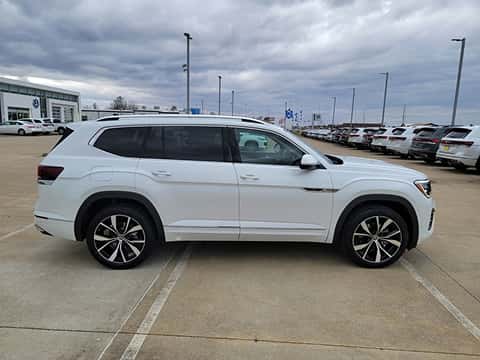
Both SUVs use turbocharged four-cylinder engines and smooth-shifting eight-speed automatic transmissions. The 2026 Atlas comes with a 2.0-liter turbo outputting 269 horsepower and 273 lb-ft of torque, while the Highlander uses a 2.4-liter turbo making 265 horsepower and 310 lb-ft of torque. Despite Toyota’s torque advantage, performance is nearly identical.
The Atlas hits 60 mph in 7.3 seconds, while the Highlander does it in 7.2 seconds. You won’t notice this gap while driving around Marion.
Fuel Efficiency and Mileage
The Volkswagen Atlas gets an EPA-estimated 25 mpg combined, which is much better than the old V-6. Base models hit 20 mpg city and 27 mpg highway, while all-wheel-drive (AWD) versions manage 26 mpg highway. Toyota’s Highlander edges ahead at 21 mpg city and 28 mpg highway. Toyota offers a 243-horsepower Highlander Hybrid starting at $47,020 that hits 35 mpg in all conditions.
Towing Capacity and Capability
Both SUVs can pull up to 5,000 pounds when properly equipped, plenty for Illinois camping or lake trips. Nearly every Atlas configuration handles the full 5,000 pounds with brake-equipped trailers. The Highlander Hybrid drops to 3,500 pounds max towing, potentially limiting bigger trailers. Both gas models handle towing confidently through Illinois.
Interior Space and Seating Capacity
The Atlas seats seven with an adult-friendly third row offering 38.3 inches of headroom and 33.7 inches of legroom. Offering up to eight seats, Toyota’s Highlander provides just 36.1 inches of headroom and 28 inches of legroom in the back. Kids fit fine, but it’s a tight squeeze for adults.
The Atlas provides 154 cubic feet of passenger space versus 139.5 cubic feet in the Highlander. You’ll find plenty of cargo space inside the Atlas with 96.6, 55.5, and 20.6 cubic feet behind the respective front, middle, and back rows, while the Highlander trails at 84.3, 48.4, and 16 cubic feet. Those extra cubic feet make a difference when you need extra room for groceries or gear without folding seats.
Front and Second-Row Comfort
Both offer cloth, leatherette, and leather seating options. The Atlas includes standard V-Tex leatherette, while Toyota charges extra for leather-trimmed seats on higher trims. Both provide three-zone climate control and heated steering wheels for Illinois winters. Plus, these SUVs offer heated and cooled seats in the front row. During hot summers, you’ll appreciate the extra cooling.
Technology and Infotainment Features
Both feature large touch screens, wireless Apple CarPlay and Android Auto, and wireless phone charging. Every Atlas comes with a 12-inch touch screen and a fully customizable Digital Cockpit. The Atlas SEL adds navigation and a head-up display, while the SEL Premium R-Line includes Harman Kardon sound. The base Highlander includes a six-speaker stereo and a smaller 8-inch screen. To get the bigger 12.3-inch display, you need to pay $735 to upgrade the screen or choose a higher trim. Atlas also provides six USB-C ports for larger families, while Toyota caps at four USB ports.
Safety Ratings and Advanced Safety Systems
Both take safety seriously with VW’s IQ.DRIVE and Toyota’s Safety Sense systems providing adaptive cruise control, lane-keeping assist, and collision prevention. The 2026 Atlas scored an overall five-star National Highway Traffic Safety Administration rating. It earned four stars in front and rollover tests, with five stars in side crash testing. These scores show good occupant protection, giving you peace of mind. The 2026 Highlander received the same ratings. The 2026 Atlas also carries an Insurance Institute for Highway Safety Top Safety Pick+ badge. You and your family can trust either SUV for excellent protection meeting federal safety standards.
Safety Technology and Warranty Coverage
Both deliver solid driver assistance that reduces fatigue and boosts awareness in challenging driving situations. The 2026 Highlander comes with Toyota Safety Sense 2.5 along with precollision systems, lane departure warnings, road sign detection, and auto high beams to help avoid crashes.
The Atlas includes full airbag coverage and stability control standard. Both offer blind-spot monitoring, rear cross-traffic alerts, and parking aids, helping you navigate Marion parking lots and intersections more confidently. As for warranties, Volkswagen’s four-year/50,000-mile warranty beats Toyota’s three-year/36,000-mile coverage.
Choose the Right Family SUV for Your Needs
The 2026 Atlas base model starts at $39,310, which is $5,960 cheaper than the Highlander’s $45,270 starting price. The Atlas gives you spacious third-row seats, best-in-class cargo room, longer warranty coverage, and standard Digital Cockpit technology.
Toyota wins on fuel economy with standard AWD and the 35-mpg hybrid option. Its reliability track record and resale values attract long-term buyers. But for true seven-person seating, maximum storage, and premium technology without the premium price, the Atlas makes more practical sense. Stop by VW of Marion to check out the Atlas yourself and see how it works for your family’s daily needs.
0 comment(s) so far on 2026 Volkswagen Atlas vs 2026 Toyota Highlander