


2026 Volkswagen Tiguan vs 2026 Toyota RAV4
Two of the compact SUV segment’s steadiest performers, one decision to make. We put together this 2026 VW Tiguan vs. Toyota RAV4 comparison because our customers ask about it constantly, and as a woman-owned, woman-led dealership built on the promise of being #NotLikeTheOtherGuys, we’d rather give you the straight facts than a sales pitch dressed up as advice. Below is what each SUV actually brings to the table.
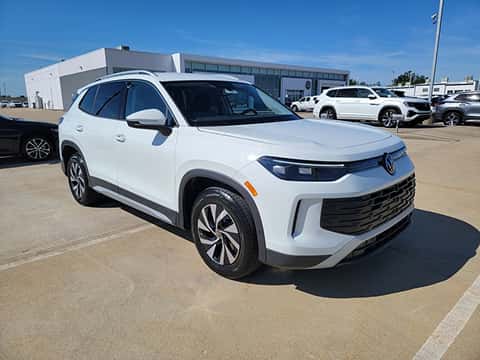
2026 Tiguan vs. RAV4: Comparing Two Compact SUV Approaches
The 2026 Tiguan and RAV4 represent two different philosophies for the same job. The Tiguan leans into cabin refinement and drivability, built around a 2.0L turbocharged four-cylinder that makes 201 hp and 207 lb-ft in front-wheel drive, 221 lb-ft with 4MOTION, and steps up to 268 hp and 258 lb-ft in the SEL R-Line Turbo. That top engine makes more horsepower than any RAV4 outside the plug-in, and it moves: 0 to 60 in the 6.7-second range against roughly 7.5 for the RAV4 hybrid.
The RAV4 has gone all-in on electrification, with no gas-only option left in the lineup. Buyers choose between a 2.5L hybrid making 226 hp in front-wheel drive or 236 hp with all-wheel drive, or a plug-in hybrid rated at 324 hp with up to 52 miles of electric range at a price well north of where the Tiguan lives. Different priorities, different customers. If you want to see current offers while you weigh your options, you can view our new vehicle specials at any point in this process.
Interior Comfort and Everyday Livability
Where you spend your time behind the wheel matters just as much as what’s under the hood, and this is where the two SUVs start to diverge in noticeable ways.
Cabin Design and Materials
This is where the Tiguan makes its clearest case. Soft-touch materials run throughout, paired with a 10.25-inch Digital Cockpit Pro cluster and 30-color customizable ambient lighting that gives the interior a more upscale feel than the price point suggests. Move up to the SEL R-Line Turbo and you get quilted Varenna leather, ventilated and massaging front seats, three-zone climate control, genuine walnut trim, a heated windshield, and a 12-speaker Harman Kardon system with a 16-channel amp. Massaging seats and a heated windshield are not things you find on a compact SUV shopping list very often.
The RAV4 was fully redesigned for 2026 and its cabin is a real step up from the outgoing model, built with durable materials aimed at active, outdoor-oriented owners, and ventilated front seats are available on its upper trims too. The difference is less about quality than about character: the RAV4 is designed to shrug off a muddy weekend, the Tiguan is designed to make a Tuesday commute feel like an upgrade.
Passenger and Cargo Space
The Tiguan offers a genuinely roomy second row, which matters if you regularly haul adult passengers or growing kids who’ve outgrown car seats. Behind that second row you get roughly 33 to 34 cubic feet, opening to about 69.8 cubic feet with the seats folded.
The RAV4 holds 37.8 cubic feet behind its second row and 70.4 with the seats down. Read that carefully, because the headline is closer than it looks: with everything folded flat, the two are separated by well under a cubic foot. The RAV4’s real advantage is loading capacity with passengers aboard, which is worth having if the back seat is always full and the hatch is always packed.
The RAV4 also tows more, at 1,750 lbs in front-wheel drive and 3,500 lbs with all-wheel drive against the Tiguan’s 1,500 and 1,800 lbs, so if a small camper or a boat is in your future, that belongs in your math. For most buyers hauling strollers, sports bags, and a Costco run, the Tiguan’s cargo hold is not the compromise the spec sheet implies.
Technology and Modern Features
The Tiguan starts ahead here and stays there. Every trim comes standard with a 12.9-inch touchscreen and a 10.25-inch Digital Cockpit Pro cluster, plus four USB-C ports with 45-watt fast charging and a ventilated 15-watt wireless charging pad. Step up to the SEL R-Line Turbo and the display grows to 15 inches, the largest screen either vehicle offers, with a head-up display and a 360-degree camera alongside it.
The RAV4 answers with a standard 12.3-inch digital cluster and touchscreens up to 12.9 inches on higher trims, running Toyota’s new Arene software with onboard 5G. Put plainly: the Tiguan’s standard screen matches the largest screen Toyota offers, and its top screen is in a different size class entirely. Natural voice control makes the Tiguan’s system feel fluid rather than menu-driven, which is the kind of thing you stop noticing precisely because it works.
Driving Experience: Refined vs. Practical
Get behind the wheel of each SUV and the personality difference becomes clear pretty quickly. The Tiguan’s turbocharged engine produces 201 hp in base trim, and the SEL R-Line Turbo trim jumps that up to 268 hp; ride quality favors smoothness and composure over long highway stretches. It’s a vehicle that rewards drivers who want a bit of engagement mixed in with daily comfort.
The RAV4’s hybrid powertrain, producing 226 hp in FWD configuration and 236 hp with AWD, prioritizes efficiency and dependability over driving excitement. Simple, predictable, and easy to live with day after day. It comes down to what you value more on your commute.
Safety Features and Driver-Assistance Systems
Safety technology has become table stakes in this segment, and both automakers deliver strong standard packages. The Tiguan comes with IQ.DRIVE as standard equipment, which includes Travel Assist and adaptive cruise control among its features, giving drivers a more active layer of assistance on the highway. The RAV4 pairs with Toyota Safety Sense 4.0, also standard, offering a strong suite of its own.
Both systems cover the fundamentals well. The Tiguan’s IQ.DRIVE suite edges ahead slightly in terms of available functionality, but RAV4 owners aren’t sacrificing meaningful safety coverage by choosing that vehicle instead.
Versatility for Real-World Ownership
Specs only tell part of the story. The real test is how these two SUVs handle your actual week: the daily commute across Marion, Illinois, the weekend trip with the whole family packed in, the errands in between.
Commuting and Daily Driving
If your daily drive involves stop-and-go traffic or a mix of highway and surface roads around Southern Illinois, both SUVs handle that duty well, but for different reasons. The Tiguan S in front-wheel drive is EPA-rated at 26/34/29 mpg, and 34 mpg on the highway is a strong number for a non-hybrid compact SUV. The SE and SE R-Line Black come in at 25/32/28, and the 268-hp SEL R-Line Turbo lands at 22/29/25, which is the honest trade for a truck-quick compact SUV with massaging leather seats.
The RAV4’s hybrid system is the efficiency leader in this segment, full stop: 48 mpg city, 42 highway, and 44 combined on front-wheel-drive models. We’re not going to pretend otherwise, and if the pump is the whole decision, Toyota wins that line item.
What that number doesn’t capture is the drive itself. The Tiguan’s quiet cabin, composed ride, and 8-speed automatic make a Marion-to-Carbondale run feel shorter, and if you’re covering ordinary commuting mileage, the annual fuel difference is smaller than most shoppers assume once you see it in dollars instead of mpg. Ask us to run those numbers against your actual commute. We’ll do it either way.
Family Transportation and Road Trips
For families juggling car seats, sports gear, and the occasional road trip, the Tiguan’s roomy second row and soft-touch materials make longer drives more comfortable for everyone in the back seat, not just the driver. Loading and unloading kids is easier with the accessible cabin layout.
The RAV4’s larger maximum cargo volume makes it a strong pick for families who prioritize hauling capacity, camping gear, or larger loads over rear-seat comfort on long trips. Rear-seat comfort and cabin refinement point you toward the Tiguan; maximum cargo space and hybrid fuel savings point you toward the RAV4.
Long-Term Value and Ownership Considerations
Long-term ownership costs matter just as much as the sticker price, and both SUVs have earned solid reputations. RAV4 ownership costs over a five-year span have generally been reasonable for the segment, though actual figures vary by trim, region, and driving habits.
The Tiguan’s value argument runs on a different axis. Volkswagen prices the SEL R-Line Turbo as a near-luxury package, with 268 hp, quilted leather, massaging and ventilated front seats, a 15-inch touchscreen, Harman Kardon audio, a head-up display, and Park Assist Plus, against vehicles from premium badges that ask considerably more for the same content. If “value” to you means what you get for the money rather than only what you spend on fuel, that comparison tends to land in the Tiguan’s favor.
As always, treat any ownership cost figures as general guidance rather than a guarantee, since real-world numbers shift based on how and where you drive.
Which SUV Fits Your Lifestyle?
If you’re drawn to a refined cabin, a more engaging drive, and tech that feels intuitive from the first time you use it, the Tiguan deserves serious consideration. The SEL R-Line Turbo’s 268 hp and 258 lb-ft make it the quickest vehicle in this comparison short of the RAV4’s plug-in, and the 15-inch touchscreen, massaging seats, and 30-color ambient lighting put it in company that usually costs more.
If maximum fuel economy and towing capacity top your list, the RAV4 remains a strong, dependable choice, and we won’t pretend otherwise. Both come from manufacturers with long track records of building solid compact SUVs.
The right one comes down to whether you’re optimizing for comfort, refinement, and drivability or for efficiency and outright utility. There’s no wrong answer here, just a better fit for your specific life.
Experience the 2026 Volkswagen Tiguan at Volkswagen of Marion
Reading specs only gets you so far. The best way to know whether the Tiguan’s cabin comfort and driving feel match what you’re looking for is to sit in it, drive it, and compare it against your daily routine firsthand.
We invite you to explore the 2026 Volkswagen Tiguan in person at our Marion, Illinois showroom, where our team can walk you through trim options, financing, and how it stacks up against whatever you’re currently driving. As a woman-owned, woman-led dealership committed to straightforward, transparent service, we’d rather answer your questions honestly than steer you toward any particular decision.
Stop by our White Frame Facility at 4403 W DeYoung St, or give our sales team a call at 618-249-3841 during business hours to schedule your test drive.
0 comment(s) so far on 2026 Volkswagen Tiguan vs 2026 Toyota RAV4